Volume 1 · Edition 02 · September 2026
The Multiplier Effect
 Human + AI
 Realizing Value
When powerful AI tools first began reaching broad audiences, one of the most compelling promises was democratization. Capabilities that had once required specialized expertise, expensive software, dedicated teams, or years of training were suddenly available through a conversational interface. Research, analysis, writing, coding, synthesis, and creative production became accessible to people who might never have had those resources before.
The intuition that followed was reasonable: if everyone gains access to increasingly capable intelligence, shouldn’t capability gaps begin to narrow?
Yet that is not what we consistently see. The same models are available to millions of people. Organizations distribute the same tools across entire workforces. Teams attend the same training and receive access to the same agents. And still, the outcomes diverge.
Some people seem to take to AI like ducks to water. They move quickly from experimentation to meaningful application, connect capabilities across problems, recognize possibilities that were not obvious at first, and begin producing work that would previously have required far more time, support, or specialized resources. Others use the same technology and experience a much smaller shift.
The difference is often attributed to prompting, technical fluency, or enthusiasm for AI. Those things matter. But I think something more fundamental is happening.
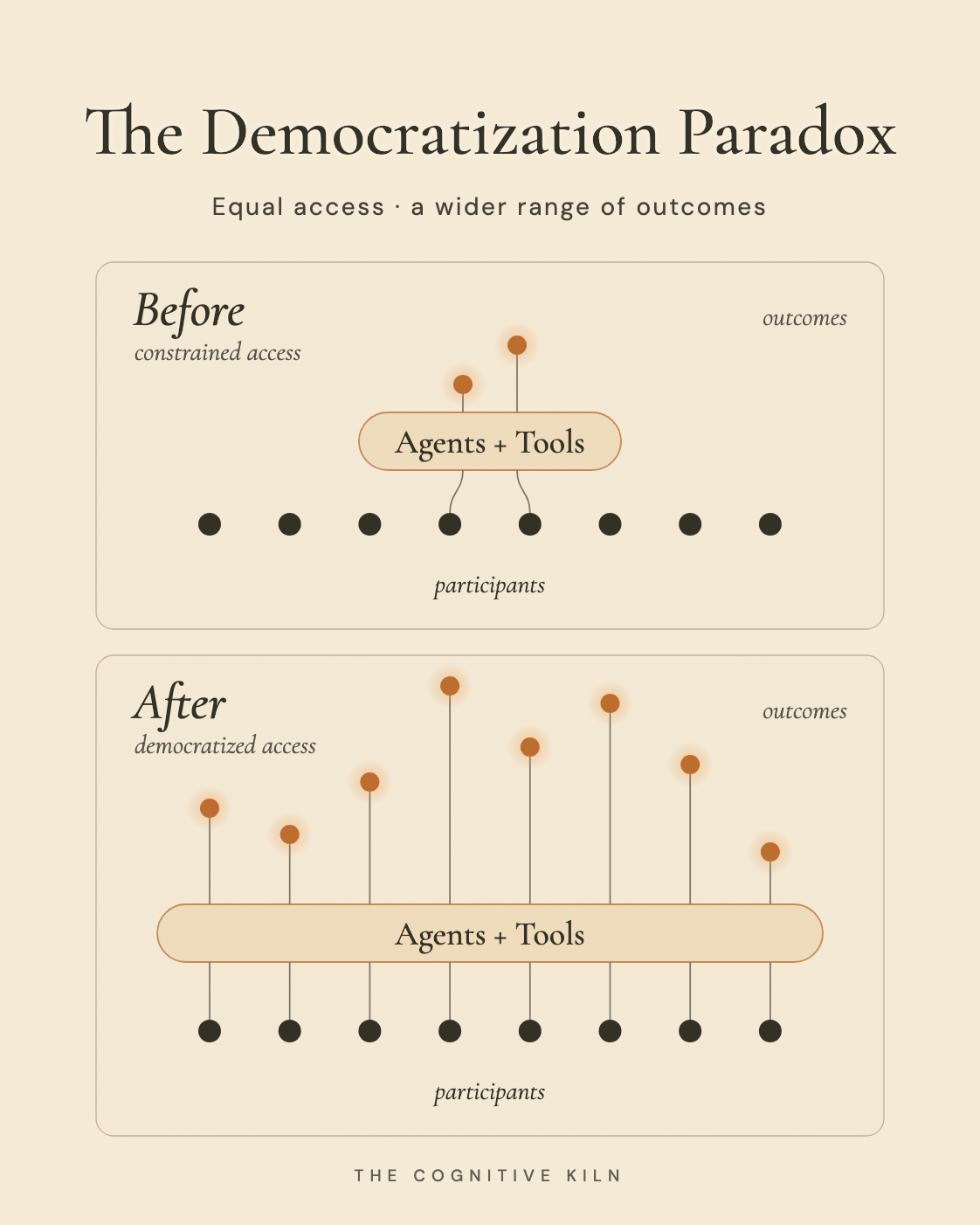
We have democratized the multiplier. We have not democratized what it multiplies.
In the previous edition of The Cognitive Kiln, I proposed a simple model for thinking about value in a Human–AI system:
Value = (Depth + Drive) × (Agents + Tools)
Depth and Drive form the human foundation. Agents and Tools provide the external multiplier. In this edition, I want to focus on the multiplication sign.
If technology behaved primarily as an addition, widespread access would have a relatively predictable effect. Give people the same new capability and each person receives roughly the same increment. Everyone moves forward.
A multiplier behaves differently because it acts on what is already there. Increasing the power of the multiplier does not necessarily compress differences in the foundation beneath it. It can make those differences more consequential.
This is the paradox at the center of AI democratization: equal access can expand opportunity while simultaneously widening the range of outcomes. Those ideas are not contradictory. They are exactly what we should expect from leverage.
Consider why some experienced practitioners seem to become dramatically more capable almost immediately after finding the right AI tools. They may suddenly draft in minutes what previously took hours, explore more possibilities before committing to a decision, interrogate unfamiliar territory, test arguments, examine alternatives, or move between levels of detail with remarkable speed.
From the outside, it can look as though the technology created the capability. But much of what we are seeing may be capability that was already present becoming newly amplified.
The practitioner already knew which questions mattered. They already possessed mental models for evaluating what came back. They knew when an answer was suspiciously neat, where exceptions tended to hide, which assumptions deserved pressure, and when a promising direction warranted further investigation.
AI did not manufacture that foundation on contact. It gave the foundation leverage.
This is the ducks-to-water effect. When a duck reaches water, the water does not create the duck’s capacity to swim. It creates the conditions under which that capacity becomes visible. AI can do something similar by revealing previously constrained capability and removing friction around its expression.
The more powerful the tools become, the more dramatic that revelation can appear.
This does not mean that people with less accumulated Depth cannot benefit enormously from AI. Quite the opposite. AI can allow someone earlier in their development to explore territory they could not previously reach. It can reduce the cost of asking questions, provide scaffolding, accelerate iteration, expose someone to alternative approaches, and make experimentation possible at a scale that would once have been impractical.
That matters because access genuinely does expand opportunity. But access to leverage is not the same thing as instant possession of everything that leverage can act upon.
A person still developing Depth may use AI to move faster while they build it. A highly experienced person may use the same tool to extend patterns of reasoning accumulated across decades. Both have gained something extraordinary, but they have not gained the same thing.
That distinction becomes increasingly important as the tools themselves become commonplace.
For much of the history of technology, access itself created scarcity. The organization that could afford the system had an advantage over the organization that could not. The professional with specialized software, computational resources, research support, or technical expertise could do things that remained inaccessible to others.
AI is eroding many of those barriers with astonishing speed. Capabilities that once required substantial infrastructure are moving into widely available platforms. Agents will become easier to deploy. Models will continue improving. Today’s premium capability will become tomorrow’s standard feature.
That is genuine democratization.
But democratization changes where advantage lives. When access to the tool is scarce, possessing the tool is differentiating. When access becomes common, possession alone stops being enough. The source of differentiation moves somewhere else.
In the Human–AI Alloy, it moves toward the foundation being amplified. When the multiplier becomes common, the base becomes decisive.
This is why organizations can purchase the same technology and still experience profoundly different returns. It is why two teams with identical licenses can develop at different speeds, and why distributing an AI assistant to ten thousand employees does not produce ten thousand equivalent increases in capability.
The technology may be standardized. What it encounters is not.
This creates a difficult measurement problem for organizations because many of the metrics available today measure distribution and activity. How many licenses were assigned? How many people logged in? How many prompts were submitted? How many agents were created? How many hours were saved?
Those measures can tell us whether the multiplier is present and whether people are using it. They cannot, by themselves, tell us what is being amplified.
A company can reach near-universal adoption and still produce wildly uneven value. That does not necessarily mean the democratization effort failed. It may mean democratization succeeded precisely at the layer where it occurred: everyone received the multiplier, but they did not suddenly acquire identical foundations.
That changes the strategic question. The challenge is no longer simply how to get AI into more hands. It is how to understand the human capability already present in those hands, how to develop what is still emerging, and how to create conditions in which that capability can engage productively with increasingly powerful tools.
The organizations that understand this will invest differently. They will still care about access and fluency, but they will be less tempted to confuse distribution with transformation.
There is another consequence. As AI improves, divergence may become easier to see rather than harder. A weak multiplier can only amplify so much. A powerful one gives the foundation beneath it greater reach.
That helps explain the strange sensation that some people are accelerating far faster than others even when they have access to the same technological curve. The multiplier is becoming more powerful for everyone, but it is interacting with different human starting points, different levels of engagement, and different accumulated capability.
The result is one of the central tensions of this technological moment: AI can be profoundly democratizing and profoundly differentiating at the same time. It can lower barriers to participation while increasing the payoff from what people already know, how they engage, and what they continue to build.
The widespread availability of intelligence does not make human foundations irrelevant. It makes their consequences larger.
But even that does not explain every difference we see. Sometimes two people appear to bring comparable capability, comparable engagement, and access to the same tools, yet what they ultimately produce still diverges. If the foundation and the multiplier are both present, something else must be happening. That is the question that I will be exploring next.
For now, the lesson is simpler:
Democratizing the tool does not democratize the outcome.
When what we democratize is a multiplier, differences do not simply disappear.
They gain leverage.