Volume 1 · Edition 03 · October 2026
The Missing Variable
 Human + AI
 Realizing Value
In the first two editions of The Cognitive Kiln, I argued that AI is best understood as a multiplier. The value of a Human–AI Alloy begins with a human foundation of Depth and Drive, amplified by increasingly capable agents and tools:
Value = (Depth + Drive) × (Agents + Tools)
That model helps explain why broader access to AI does not produce more uniform outcomes. The same technological multiplier acts on different human foundations. Experience differs. Engagement differs. The accumulated mental models people bring to the work differ.
But there is still a case the equation does not fully explain.
Imagine two people with comparable Depth. Both understand their domain. Both are motivated to engage. Give them access to the same model, the same tools, the same information, and enough time to work with them. Their outcomes can still diverge.
One person emerges from the interaction with something that has become part of how they think. They can reconstruct the idea, connect it to what they already know, modify it when the context changes, and continue working with it without returning immediately to the original output. The other may produce an equally polished artifact, yet much of the intelligence remains external. Remove the generated artifact and surprisingly little has changed inside the human system.
Both used AI. Both received useful output. Both may have produced work that looks successful.
AI can make intelligence available without making it ours.
That is the missing variable.
Before generative AI, shallow understanding often left fingerprints.
A person who had not internalized something might struggle to explain it clearly, organize it coherently, or produce a convincing artifact from it. The weakness in understanding often appeared somewhere in the work. Fluency and capability were never identical, but the gap between them was harder to conceal.
Generative systems can now remove many of those visible signals.
Someone can create a sophisticated analysis of a subject they have barely begun to understand. They can generate polished recommendations, clear explanations, elegant slides, working code, or detailed plans far beyond what they could have produced unaided. That is an extraordinary expansion of capability.
It also means that artifact quality and internalized capability can temporarily separate.
A strong artifact may reflect deep human understanding, excellent machine assistance, or some combination of the two. It may also reflect very little internalization by the person presenting it. The artifact itself cannot reliably tell us which is true.
This matters because organizations have historically used visible output as a proxy for capability. Good work suggested good understanding. Strong communication suggested grasp of the underlying material. Repeated performance suggested learning had occurred.
Those proxies are becoming less dependable.
AI can help someone produce beyond the boundaries of what they have personally integrated. That is often useful. Sometimes that is exactly the point. But it creates a new measurement problem: if output quality can rise faster than human understanding, then output alone can no longer tell us what capability has actually been developed.
The distinction is not between “real” work and AI-assisted work. It is between intelligence that is available to the person and intelligence that has become usable from within their own cognitive system.
I use the word metabolization to describe that conversion.
Metabolization is the in-context conversion of available intelligence into internalized human capability. It describes how much of what becomes available through the Human–AI Alloy is actually processed, connected, incorporated, and made usable by the person engaging with it.
That expands the original model:
Realized Value = Metabolization × [(Depth + Drive) × (Agents + Tools)]
Depth and Drive still form the human base. Agents and tools still provide the external multiplier. Metabolization separates what the combined system can make available from what is actually realized by the human within that system.
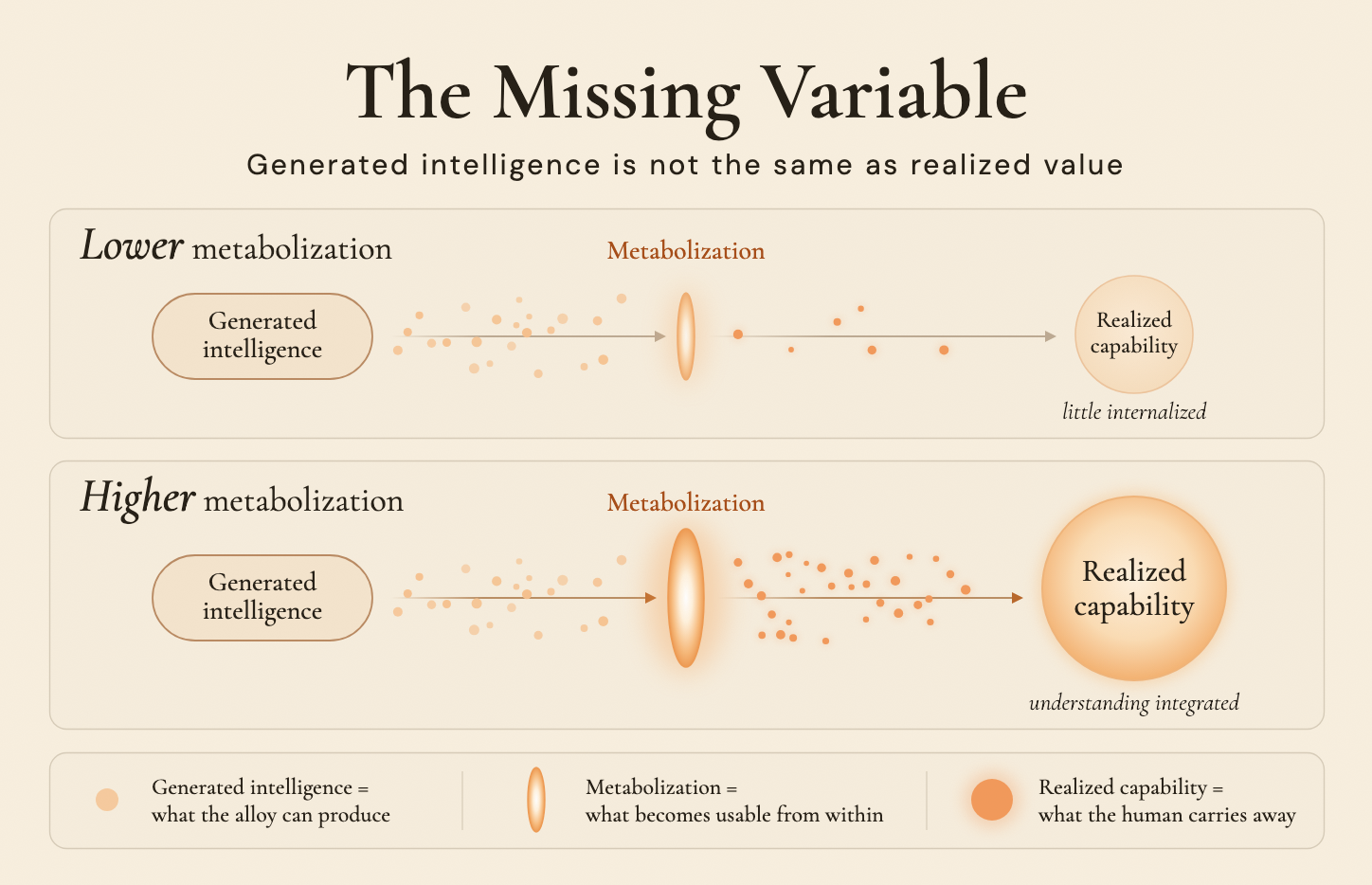
A model can produce an elegant explanation of a complex problem in seconds. It can structure an argument, identify relationships, synthesize information, generate alternatives, and express them with extraordinary fluency. None of that tells us what happened inside the person reading the response.
They may have integrated it deeply. They may have absorbed only part of it. They may have understood it well enough for the immediate task but not well enough to reconstruct it later. Or they may simply have moved the output from one system into another.
This is where the distinction between generated thinking and authored thinking begins to matter.
I am using authored narrowly here. I am not yet asking who philosophically, intellectually, or legally owns an AI-assisted idea. For now, the distinction is cognitive. Generated thinking is intelligence that has been produced and made available to us. Authored thinking is intelligence that has been sufficiently metabolized to participate in our own understanding.
The difference is not whether AI was involved. AI may be deeply involved in both. The difference is what happens after generation.
Suppose I ask an AI system to explain a concept I do not understand. It gives me a clear and accurate response, and I use part of that response in a presentation. The presentation may create real value, but that does not establish that I now understand the concept. If someone changes the conditions, asks me to restate the underlying relationship, or removes the language the system gave me, I may discover that what looked like capability was still largely external.
Now imagine that I keep working with the explanation. Something does not quite fit with what I already know, so I ask the system to approach the problem differently. I reformulate the idea in my own terms, connect it to prior experience, and test whether it still holds when the example changes. Eventually, I no longer need the original wording because the relationship itself has entered my mental model.
The AI contributed in both cases. The cognitive state is different.
Metabolization also does not require direct interaction with the system that first generated an idea. An idea may reach us through a colleague, a document, or another artifact and still become part of our own understanding. The relevant question is not simply where the idea originated, but what happens when it encounters the person receiving it.
That is enough to complicate the old assumption that creation and understanding necessarily travel together.
There is another complication: metabolization is state-dependent.
The same person can metabolize the same kind of material differently under different conditions. Cognitive load matters. Time matters. The safety of the setting matters. The amount and form of assistance available can matter.
A highly capable person working under heavy cognitive load may be able to receive information without having enough available capacity to integrate it deeply. Someone who understands a subject well may still process new material differently in a setting where uncertainty feels costly. Complex material that is difficult to absorb alone may become more workable when appropriate assistance is present.
None of those conditions necessarily change the person’s underlying Depth, and they do not necessarily change their Drive. They change the conversion occurring in that particular moment.
That is why metabolization belongs outside the human foundation in the equation. If it were simply another form of Depth, an expert would metabolize consistently. If it were simply Drive, effort could always overcome it. Neither is true.
The variable describes the state of conversion, not the quality of the person.
Otherwise, we risk turning a momentary cognitive condition into a capability judgment. A person may be fully capable of understanding something and still fail to metabolize it in a particular setting. Another may integrate it rapidly because the timing, framing, or support is different.
The Human–AI Alloy is therefore not static. The same human foundation, paired with the same tools, can produce different realized value depending on what happens during the interaction itself.
For organizations, this creates a practical problem.
Many AI programs still measure what is easiest to count: licenses activated, prompts submitted, time saved, tasks completed, artifacts produced. Those measures can tell us whether the technology is being used. They cannot tell us what the human system is learning.
A person can use AI constantly without metabolizing much of what passes through the interaction. Another can use it less visibly while deeply incorporating what they encounter. From the outside, the first person may appear more advanced. Inside the cognitive system, something very different may be happening.
This does not mean every interaction with AI needs to become a learning exercise. Sometimes delegation is the point. Sometimes we want the answer, the draft, the calculation, or the completed task. The mistake is treating all of those interactions as though they produce the same kind of value.
Organizations therefore need to become more precise about what they are trying to improve. If the goal is throughput, externalized intelligence may be enough. If the goal is capability development, then polished output is not sufficient evidence that learning has occurred.
That distinction matters for enablement, workforce development, and leadership. If we measure only what the alloy produces, we may miss what is happening to the human inside it.
And that is becoming increasingly important because the supply of generated intelligence is no longer the obvious constraint.
Answers are abundant. Explanations are abundant. Drafts, analyses, alternatives, summaries, and recommendations can be produced at a scale that would have been prohibitively expensive only a few years ago.
The system can generate faster than the human necessarily integrates.
When we ignore that gap, we risk mistaking an abundance of output for an abundance of realized capability.
Metabolization gives us language for that difference.
It inserts a necessary step between what the Human–AI Alloy can produce and what has actually become available inside the human side of the system. It explains why comparable people with comparable tools can still walk away with different amounts of realized capability, and why sophisticated output does not always tell us how much understanding has been built.
The first equation asked what AI amplifies. The second asked what happens when that multiplier becomes widely available. This one asks what happens after the intelligence arrives.
Because increasingly, generation is not the difficult part.
Intelligence is not realized when it is generated. It is realized when it is metabolized.
And once intelligence itself becomes abundant, another question begins to surface:
What becomes scarce?