Volume 1 · Edition 01 · August 2026
The Human–AI Alloy
 Human + AI
 Realizing Value
Over the past year, I found myself returning to the same question in workshops, executive briefings, and the conversations that inevitably continue long after the session ends.
If increasingly capable AI is becoming available to everyone, why are the outcomes becoming more different rather than more similar?
Organizations are deploying the same models. Teams are experimenting with the same tools. Individuals have access to the same capabilities. Yet some people seem to compound almost effortlessly, while others struggle to create value beyond the novelty of the technology itself.
The obvious explanation is AI literacy. Better prompting. Better workflows. Better tools. These explanations are not wrong, but they are incomplete. They assume that value originates in the technology.
I have come to believe the more important question is different.
What, exactly, is AI amplifying?
The most capable cognitive system is increasingly neither the human working alone nor the autonomous AI acting independently. It is the combination of the two: a coupled system in which human capability and artificial intelligence amplify one another.
I call this the Human–AI Alloy.
The strategic question, then, is no longer simply whether organizations should adopt AI. That question has largely been settled. The more important question is what determines the value of the alloy itself.
I believe the answer begins with a simple proposition:
Value = (Depth + Drive) × (Agents + Tools)
The equation is intentionally simple.
Depth represents accumulated capability: experience, judgment, domain knowledge, pattern recognition, and the mental models that allow a person to distinguish between an output that sounds plausible and one that is actually useful. Depth is built slowly. It is earned through exposure, reflection, error, repetition, and the consequences of prior decisions.
Drive is the active willingness to engage with new capability: to experiment, learn, adapt, and move beyond established ways of working. It may originate in personal initiative, or it may be activated through organizational support, education, relevant use cases, and the opportunity to practice. Drive is not a fixed personality trait, nor is it a judgment of effort. It describes whether the human part of the alloy is presently leaning into the multiplier available to it.
Depth describes what a person brings.
Drive describes whether that capability is actively entering the alloy.
The two are added rather than multiplied because one can carry the other for a time. Accumulated capability does not disappear when engagement is low, and strong engagement can move a person forward while judgment is still being built.
Agents and tools represent the external multiplier. Today, that includes generative models, intelligent agents, automation, search, and collaborative technologies. Tomorrow, it will include capabilities we have not yet imagined. The equation is written this way deliberately. The tools will change. The relationship between the human foundation and the multiplier will remain.
The multiplication sign is the most important part of the equation.
A multiplier does not contribute a fixed amount of value. It acts on what is already there.
That is why the same AI assistant, placed in the hands of two different people, does not produce the same result.
A junior employee may have extraordinary drive. They may experiment constantly, teach themselves new systems, test new workflows, and lean readily into complexity. AI can accelerate their development and extend what they are able to do. But enthusiasm and access do not instantly create the judgment that comes from years of experience. Their alloy may be fast-moving and full of potential while still requiring guidance, feedback, and exposure to build depth.
A senior practitioner may bring decades of accumulated judgment. They know where the exceptions hide, which assumptions deserve scrutiny, and which answers merely sound convincing. Yet that depth may remain outside the alloy if they are weary of another technology cycle, unconvinced by the use cases, or unsupported through the mindset shift required to work with probabilistic systems.
The opportunity in that case is substantial. Once engaged, AI does not replace their accumulated capability. It compounds it.
Seen this way, organizations are not introducing a uniform AI layer across a uniform human base. They are applying the same multiplier to very different combinations of Depth and Drive.
Many AI rollouts still treat access as the primary unit of progress. Licenses are distributed, adoption is measured, training is standardized, and usage becomes the proxy for transformation. But equal access does not mean equal readiness, and equal usage does not mean equal value. A workforce is not a neutral surface onto which an AI layer can be applied. It is a varied landscape of accumulated judgment, current engagement, institutional memory, curiosity, skepticism, confidence, and developmental need.
That variation is not a problem to eliminate. It is the human reality that AI strategy must learn to see. The technology may be deployed uniformly, but the foundations it meets are not uniform, and the resulting value will not be uniform either.
Those combinations create four distinct starting points, illustrated below.
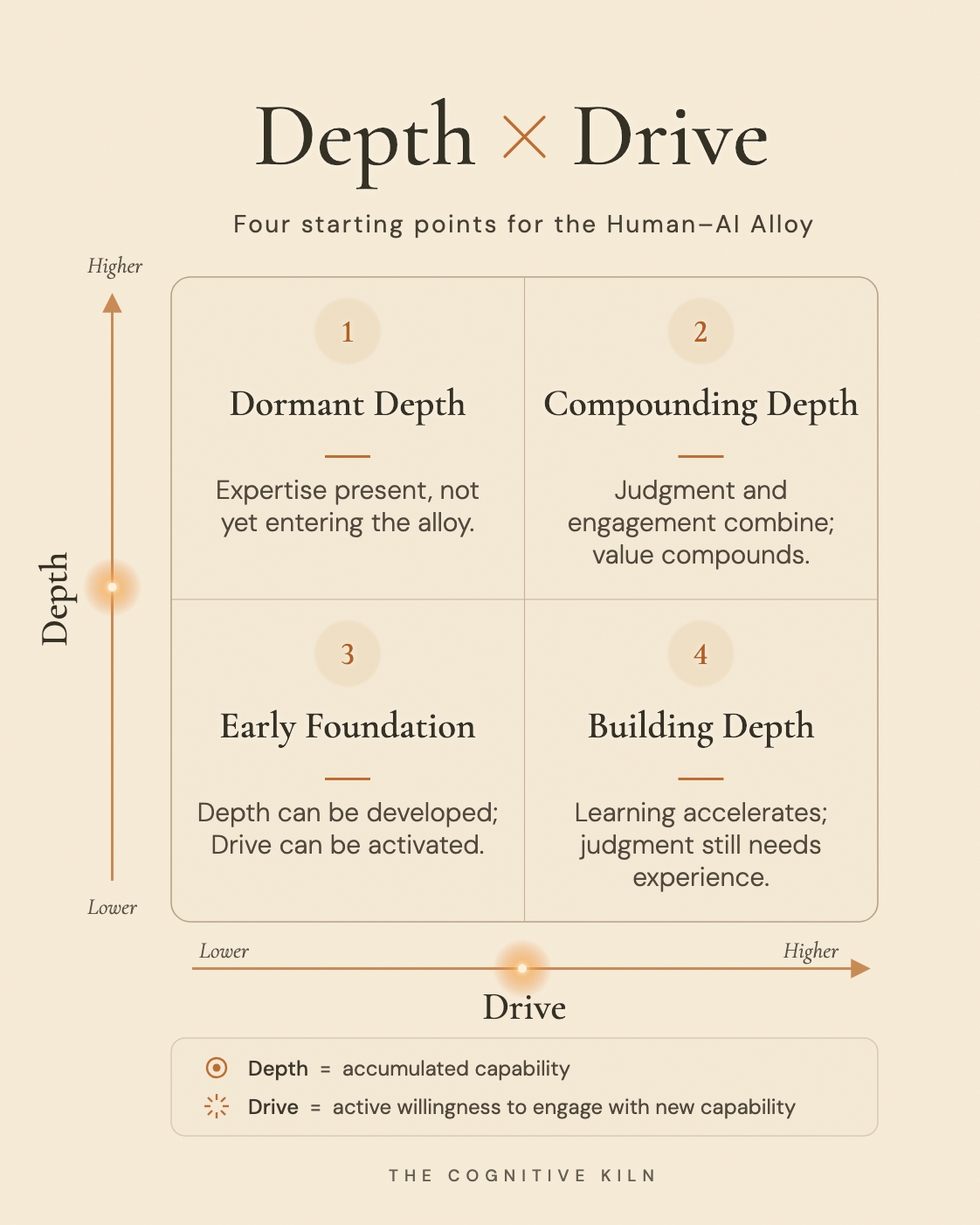
Read in numerical sequence, the quadrants describe four different ways capability can enter the alloy.
1. Dormant Depth
When Depth is high and Drive is lower, valuable capability exists but is not yet fully entering the alloy. The person may be skeptical, fatigued by years of technology churn, unconvinced that the tools are relevant to their work, or simply lacking a meaningful point of entry. This is not the same as incapability, and it should not be treated as a permanent identity. In many organizations, this may be one of the most strategically important quadrants because a well-designed learning experience, a credible use case, or the opportunity to solve a problem that matters can activate engagement quickly. When that happens, years of accumulated expertise become available to the multiplier.
2. Compounding Depth
When both Depth and Drive are high, the individual brings accumulated judgment and is actively learning how to extend it through AI. They can challenge outputs, redirect the system, recognize weak reasoning, and integrate new capability into an already developed understanding of the domain. This is where AI can generate disproportionate value: not because the technology is different, but because the foundation it is amplifying is both substantial and engaged.
3. Early Foundation
When both Depth and Drive are presently low, access to more sophisticated tools is unlikely to create meaningful value by itself. But this quadrant is not a verdict. Depth can be developed. Drive can be activated. Both are shaped not only by the individual, but by the environment around them: the quality of leadership, the relevance of the work, the availability of support, the permission to experiment, and the consequences attached to failure.
4. Building Depth
When Drive is high but Depth is still developing, AI can accelerate learning, exploration, and contribution. This is often where junior employees appear most impressive: they adopt quickly, experiment freely, and use the technology to reach beyond the limits of their current experience. But speed of adoption should not be mistaken for completeness of judgment. The leadership response is not to restrict access. It is to surround that access with mentoring, feedback, apprenticeship, and opportunities to learn from consequences. AI can help build Depth, but it does not eliminate the need to build it.
The practical mistake would be to respond to all four starting points with the same intervention. Dormant Depth needs relevance, trust, and a credible invitation into the technology. Compounding Depth needs room to experiment, access to meaningful problems, and protection from processes that slow its momentum. Early Foundation may require both capability development and a reason to engage. Building Depth needs mentoring, feedback, and exposure to consequences.
A uniform rollout therefore risks underdeveloping the junior employee, alienating the experienced practitioner, and constraining the person already creating disproportionate value. The technology may be standardized. The path into the alloy cannot be.
Drive is partly personal, but it is never purely personal. Organizations can activate it or suppress it. They activate it when people are given relevant examples, protected time, permission to experiment, access to peers, and the psychological safety to be temporarily incompetent with a new system. They suppress it when access is tightly controlled, experimentation creates risk without reward, training is detached from real work, or adoption is framed as compliance.
A person who appears disengaged may not lack curiosity. They may lack a credible path into the technology. A person who appears highly driven may be compensating for an organization that has left capability development entirely to the individual. The matrix should therefore be read as a diagnostic of the system around the person as much as of the person themselves.
The figure is not a way to rank people. It is a way to see the conditions under which value is, or is not, being created.
People can move between quadrants. A junior employee building Depth may become a powerful compounder over time. A deeply experienced practitioner may move from Dormant Depth to Compounding Depth once the technology becomes relevant and intelligible. Drive may rise when people are given time, support, and meaningful problems. It may also fall when experimentation is discouraged, access is constrained, or adoption is reduced to another mandatory rollout.
That is why AI strategy cannot be reduced to technology strategy.
Organizations can purchase the same models, deploy the same copilots, and provide access to the same agents. What they cannot assume is that those tools are acting on the same human foundation.
Equal access does not create equal alloys.
This reframes the questions leaders need to ask.
- Where does Depth reside in the organization?
- Where is Drive already present?
- Where could Drive be activated?
- Which junior employees need the mentorship that will turn rapid adoption into durable judgment?
- Which experienced employees are carrying valuable Depth that has not yet been invited into the new system?
- And are we investing as deliberately in the human foundation as we are in the multiplier applied to it?
The widespread availability of AI has led many to predict the democratization of expertise. I believe something more nuanced is emerging.
Access to sophisticated agents and tools will continue to spread. Over time, that part of the equation will become increasingly common.
The multiplied base will not.
Depth still has to be developed. Drive still has to be activated and sustained. The same technology will therefore continue to produce different outcomes because it is entering different human systems.
AI does not flatten those differences.
It makes them more consequential.
The organizations that benefit most from AI will not necessarily be those with the most advanced technology.
They will be those that understand what they are amplifying — and learn how to build the strongest alloys.